Tel: +86-27-59323486 E-mail: info@cs-vehicle.com
- All
- Product Name
- Product Keyword
- Product Model
- Product Summary
- Product Description
- Multi Field Search

Views: 358 Author: Site Editor Publish Time: 2026-06-16 Origin: Site


The rapid growth of e-commerce over the past decade has fundamentally reshaped global logistics operations. Traditional supply chains once focused on transporting bulk goods from manufacturers to retail stores have evolved into dynamic systems designed to deliver individual orders directly to consumers. This transformation has increased the complexity of logistics networks, requiring companies to optimize how goods are stored, transported, and distributed.
As online shopping becomes part of everyday life worldwide, customer expectations for delivery speed and reliability continue to rise. Consumers now expect shorter delivery times, accurate tracking, and damage-free shipments regardless of distance or order size. For logistics providers and e-commerce platforms, meeting these demands has become essential to maintaining competitiveness. As a result, transportation efficiency has emerged as a key differentiator in modern logistics.
E-commerce has reshaped consumer behavior by prioritizing convenience and speed. Services such as next-day delivery, same-day shipping, and real-time order tracking have become standard expectations rather than premium offerings. Customers increasingly evaluate brands not only by product quality but also by delivery performance.
This change creates enormous pressure on logistics providers. Faster delivery requires tighter schedules, optimized transportation routes, and vehicles capable of handling frequent loading and unloading cycles without compromising efficiency.
Unlike traditional retail logistics, where shipments moved in predictable bulk volumes, e-commerce logistics must handle fluctuating order quantities daily. Delivery fleets must therefore remain flexible while maintaining consistent performance.
The rise of direct-to-consumer business models has further accelerated delivery demands. Manufacturers and brands increasingly ship products directly from warehouses to customers, bypassing physical retail channels entirely.
This model introduces several operational challenges:
· Increased shipment frequency
· Smaller but more numerous cargo loads
· Greater geographic delivery coverage
· Higher expectations for shipment safety
To support DTC logistics, companies require vehicles capable of transporting diverse goods efficiently while protecting cargo integrity. Box cargo trucks provide standardized enclosed space that simplifies loading processes and reduces handling risks.
Urban areas represent the most challenging environment for logistics operations. High traffic density, limited parking access, and strict delivery time regulations require vehicles that are both maneuverable and efficient.
Key urban delivery pressures include:
· Congested road networks
· Frequent delivery stops
· Limited loading zones
· Environmental efficiency requirements
Van cargo trucks offer an optimal balance between cargo capacity and urban drivability, allowing logistics companies to maintain delivery efficiency even in densely populated cities.
Modern logistics systems require transportation solutions that combine flexibility, efficiency, and reliability across increasingly complex supply chains. As e-commerce and rapid distribution models continue to expand, logistics providers must move goods quickly between warehouses, distribution hubs, and end customers while maintaining operational control and cost efficiency. Within this environment, the box cargo truck has become an essential transportation tool supporting both regional and urban logistics operations.
Unlike rail or air freight, which operate on fixed routes and schedules, box cargo trucks offer unmatched operational flexibility. They can adapt to changing delivery routes, fluctuating shipment volumes, and diverse cargo requirements without requiring additional infrastructure.
This flexibility allows logistics companies to respond quickly to real-time demand changes, seasonal sales peaks, and unexpected supply chain disruptions. Compared with larger heavy-duty trucks, box cargo trucks are easier to maneuver in dense urban environments while still providing sufficient cargo capacity for commercial distribution. As a result, businesses gain the ability to optimize routes dynamically and maintain efficient delivery performance across different regions.
One of the most significant advantages of box cargo truck transport is its ability to provide direct point-to-point delivery. Goods can be transported from warehouses or fulfillment centers directly to retail locations, businesses, or consumers without multiple transfer stages.
Reducing cargo handling steps minimizes the risk of damage, delays, and logistical errors. Direct delivery also shortens transit times and simplifies coordination across the supply chain. For e-commerce operations managing high order volumes, this streamlined transportation process improves delivery reliability while lowering overall operational costs.
Last-mile delivery remains one of the most challenging and expensive segments of modern logistics. Urban congestion, limited parking space, and frequent stops require vehicles that balance maneuverability with cargo efficiency.
Box cargo trucks are ideally suited for this role. Their enclosed structure protects packages during frequent loading cycles, while their moderate size allows efficient navigation through city streets and residential areas. Logistics companies rely on these vehicles to complete high-frequency delivery routes, ensuring parcels reach customers safely and on schedule.
By improving delivery consistency and reducing failed delivery attempts, box cargo trucks help companies enhance customer satisfaction while maintaining operational efficiency in densely populated markets.
Beyond last-mile operations, box cargo trucks play a vital role in connecting warehouses, regional distribution centers, and fulfillment hubs. They enable continuous inventory movement between logistics nodes, ensuring stock availability aligns with real-time demand.
This inter-facility transportation function supports inventory balancing, rapid replenishment, and flexible distribution planning. Because box cargo trucks can operate efficiently across short and medium distances, they provide an ideal solution for regional logistics networks where speed and adaptability are critical.
As supply chains become increasingly decentralized, the ability to maintain smooth connections between logistics facilities has become essential. Box cargo trucks help create an integrated transportation ecosystem that supports scalable and responsive e-commerce operations.
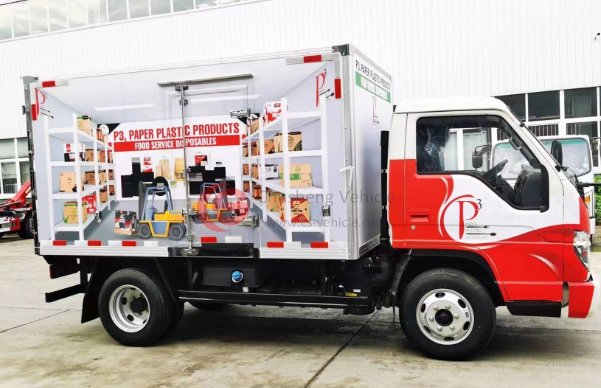
One of the defining features of a box cargo truck is its fully enclosed cargo body. This structure protects goods from environmental exposure such as rain, dust, sunlight, and temperature fluctuations.
Cargo security also improves significantly. Enclosed compartments reduce theft risks during transportation or temporary stops, which is especially important for high-value e-commerce goods such as electronics and consumer products.
The rectangular cargo design allows for standardized loading using pallets, containers, or shelving systems. This maximizes usable space and improves loading efficiency.
Benefits include:
· Faster loading and unloading times
· Better cargo organization
· Reduced damage caused by shifting loads
· Increased delivery volume per trip
Efficient space utilization directly translates into improved operational productivity.
Compared with larger heavy-duty trucks, box cargo trucks offer lower fuel consumption and maintenance costs while still providing sufficient payload capacity for most delivery tasks.
Vehicle Type | Cargo Capacity | Operating Cost | Urban Suitability |
Delivery Van | Low | Low | High |
Medium Truck | High | High | Moderate |
Box Cargo Truck | Medium–High | Balanced | Excellen |
This balance makes box cargo trucks particularly attractive for logistics companies seeking cost efficiency without sacrificing capability.
E-commerce logistics requires vehicles that can operate continuously throughout the day. Reliable box cargo trucks are designed for durability, enabling repeated delivery cycles while maintaining performance stability.
Their design supports:
· Frequent door openings
· Repetitive loading operations
· Extended operating hours
· Diverse cargo types
Modern e-commerce supply chains rely on fast, flexible, and reliable transportation systems to maintain operational efficiency. Box cargo trucks play a crucial role in supporting logistics networks by enabling smooth inventory movement, efficient regional distribution, scalable fleet expansion, and consistent delivery performance.
Logistics networks depend on continuous inventory transfers between distribution centers and fulfillment hubs. Box cargo trucks provide efficient mid-range transportation that helps warehouses maintain optimal stock levels and respond quickly to changing demand. Their enclosed cargo space protects goods during transit while allowing frequent replenishment cycles. As a result, companies can reduce stock shortages, improve order processing speed, and prevent fulfillment delays that negatively impact customer experience.
Regional delivery routes often involve transporting mixed cargo types to multiple destinations within urban and suburban areas. Box cargo trucks offer adaptable cargo capacity capable of handling varying shipment sizes without sacrificing efficiency. Standardized vehicle fleets simplify route planning, loading operations, and fleet management, enabling logistics providers to optimize delivery schedules while maintaining consistent operational performance.
As e-commerce businesses expand, transportation capacity must grow accordingly. Box cargo trucks feature standardized configurations that allow companies to scale fleets without redesigning existing workflows. This scalability provides predictable performance, simplified driver training, easier maintenance scheduling, and consistent delivery efficiency across expanding logistics networks.
Reliability remains a key factor in logistics success. Enclosed cargo protection, stable vehicle handling, and dependable operational performance help minimize delivery disruptions. By reducing risks related to cargo damage, mechanical issues, and inefficient loading processes, box cargo trucks contribute to higher delivery accuracy, improved customer satisfaction, and stronger brand trust within competitive e-commerce markets.
In today’s rapidly evolving digital economy, logistics efficiency has become a defining factor in the success of e-commerce operations. As delivery expectations continue to rise and shipment volumes grow, businesses must rely on transportation solutions that combine reliability, flexibility, and operational efficiency. The box cargo truck has emerged as a vital component of modern logistics systems, supporting stable cargo protection, streamlined distribution processes, and consistent delivery performance across diverse operating environments.
By enabling smooth connections between warehouses, regional distribution centers, and last-mile delivery networks, box cargo trucks help logistics providers maintain cost control while improving service reliability. Their scalable design allows fleets to expand alongside business growth, making them an essential long-term investment for companies seeking sustainable logistics development.
Selecting a professional vehicle manufacturer is equally important to ensure durability and operational stability. CHUSHENG VEHICLE GROUP CO., LTD., with extensive experience in special-purpose vehicle manufacturing and global exports, offers engineered box cargo truck solutions tailored to real-world logistics demands. Businesses looking to enhance delivery efficiency and fleet performance are encouraged to explore customized solutions and consult with CHUSHENG VEHICLE GROUP CO., LTD. for professional guidance and reliable transport options.
Q: Why are box cargo trucks ideal for e-commerce logistics?
A: They provide secure, enclosed storage, flexible cargo arrangements, and maneuverability for urban and regional deliveries.
Q: How do box cargo trucks protect goods during transit?
A: Enclosed cargo compartments, reinforced doors, and optional refrigeration ensure parcels remain safe from weather, theft, and damage.
Q: What maintenance practices keep box cargo trucks reliable?
A: Regular inspections, preventive maintenance of engines, brakes, suspension, and cargo compartments ensure long-term reliability.
Q: How do box cargo trucks improve delivery efficiency?
A: Multi-access doors, organized cargo interiors, and compact maneuverable designs allow faster loading, unloading, and multiple daily stops.